- What Exactly is a Scar?
- How does Facial Scarring Happen?
- What Type of Scars can Plasma Fibroblast Therapy Treat?
- How can Plasma Fibroblast Therapy Treat Scarring?
- How Long Does Fibroblast Therapy for Scars Take to Heal?
- What Scars Should a PlasmaPen Not be Used on?
- Shop PlasmaPen’s Range of Industry-Leading Devices and Products
Using a PlasmaPen for scars, sometimes called fibroblast for scars, can significantly reduce the appearance of damaged tissue. However, it cannot treat every scar type, and it must never be attempted on one specific variety. Scar revision is an advanced procedure that sits well above basic aesthetic qualifications, requiring specialised practitioner training to ensure safe, effective outcomes.
What Exactly is a Scar?
To understand how plasma fibroblast therapy works, it is essential to understand what scar tissue actually is. Scarring is a completely natural part of the wound-healing process. Aside from very minor superficial lesions, almost every wound leaves some degree of scarring behind.
What you are looking at when viewing a scar is fibrous tissue that has replaced normal skin; it is not simply damaged skin but replacement tissue. The primary difference lies in the alignment of collagen fibres. In healthy, undamaged skin, collagen forms a criss-cross, basket-weave structure. In scar tissue, the collagen lines up in rigid, parallel rows. This single structural difference explains why scar tissue is weaker, less elastic, and behaves differently from the surrounding healthy skin.
How does Facial Scarring Happen?
Facial scarring occurs when the deeper dermal layer of skin is disrupted or damaged. Common causes include inflammatory acne breakouts, surgical incisions, accidental cuts, burns, insect bites, and facial trauma. As facial skin is constantly exposed to environmental movement, sun exposure, and delicate micro-expressions, facial scars can often heal unevenly, leading to textural irregularities such as pitted indents or raised tissue.
What Type of Scars can Plasma Fibroblast Therapy Treat?
Plasma fibroblast therapy is highly effective for specific classifications of scarring, primarily atrophic scars, hypertrophic scars, and stretch marks.
Atrophic scarring is the indented, pitted type most commonly left behind by severe acne or chickenpox. Hypertrophic scarring involves an excessive buildup of collagen tissue over a wound site that remains strictly within the original borders of the injury. Stretch marks can also be successfully treated.
The treatment technique is deliberate and varies by scar type:
- Atrophic Scarring: The area is mapped with a white pencil, then the practitioner dots around the edge of each scar rather than into the middle of it, because the aim is to stimulate collagen in the tissue surrounding the indentation so that it lifts toward the level of the skin around it. Only on a very small scar do they spray inside. Everything else is worked from the edge, outward.
- Hypertrophic Scarring: The work is dotted over the excess skin, covering the whole protruding area above the skin.
- Stretch Marks: The practitioner dots around the periphery of each mark, then inside it, to create contraction on the elastic fibres within.
To learn more about how plasma energy interacts with dermal cells, read our full guide on what plasma fibroblast therapy is.
How can Plasma Fibroblast Therapy Treat Scarring?
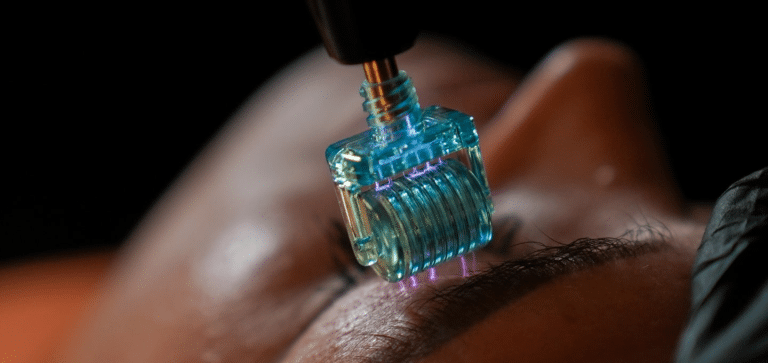
Plasma fibroblast therapy works by delivering targeted thermal energy via an ionised gas arc to the treatment area. This process sublimates (instantly converts solid tissue to gas) tiny micro-points on the surface of the scar without causing thermal damage to surrounding deep structures.
This controlled micro-injury triggers the body’s natural healing response, breaking down rigid, parallel collagen alignment and stimulating dermal fibroblasts to produce fresh, criss-crossed collagen and elastin. Over a series of sessions, this remodelling process softens dense scar tissue, flattens raised areas, and plumps indented depressions to blend the scar seamlessly with surrounding skin.
How Long Does Fibroblast Therapy for Scars Take to Heal?
Healing times depend significantly on whether the treatment is performed on the face or the body. For facial scar treatments, carbon crusts remain visible for roughly five to seven days before shedding naturally. Body scars require a longer recovery window; carbon crusts on the body typically last ten to 14 days, and clients should expect double the overall healing time compared to facial work.
Throughout the crusting phase, the area must be kept dry, and clients should be told not to shower directly over it. Friction from clothing can dislodge body crusts prematurely, which risks worsening the scar, so wearing loose clothing or applying a breathable dressing during the day, uncovered again at home, is recommended. Following body treatments, strict sun avoidance is required for up to 15 weeks.
Multiple sessions are usually required to achieve optimal results. Retreatment on scar tissue can take place every four weeks for two to three sessions, as sublimating excess tissue allows for slightly shorter intervals than standard full-face skin tightening.
Scar revision is a gradual, artistic process rather than an exact science, so total erasure of a scar is impossible. The realistic objective is to noticeably reduce its visibility, depth, and texture.
For complete recovery steps and product recommendations, read our official PlasmaPen aftercare guide and browse our collection of aftercare products, specifically formulated to aid the healing process.
Including real technicians’ results following plasma treatment.
What Scars Should a PlasmaPen Not be Used on?
Plasma fibroblast therapy must never be used on keloid scars or on individuals with a personal or familial history of keloid formation.
Unlike hypertrophic scars, keloid scars grow beyond the boundaries of the original wound site due to an aggressive, uncontrolled overproduction of collagen. Plasma fibroblast therapy relies on creating controlled micro-injuries to stimulate a healing response, and applying it to keloid-prone skin will actively trigger keloid growth and severely exacerbate the condition.
Furthermore, plasma treatment should never be used on unexplained skin lesions, open wounds, recently changed moles, or clients with underlying collagen disorders affecting wound healing.
Shop PlasmaPen’s Range of Industry-Leading Devices and Products
Transforming scar tissue demands superior technology, specialised pre-treatment numbing formulations, and targeted post-procedure serums.
Explore PlasmaPen’s market-leading range of professional devices, including the PlasmaPen, CoolJet™, and the Fusion Series, alongside our specialised pre-treatment solutions and post-treatment repair products to deliver safe, dramatic scar revision results in your clinic today. You can also browse our technician directory to find a qualified practitioner for your treatment. If you have any further questions about our products or training services, please don’t hesitate to get in touch.
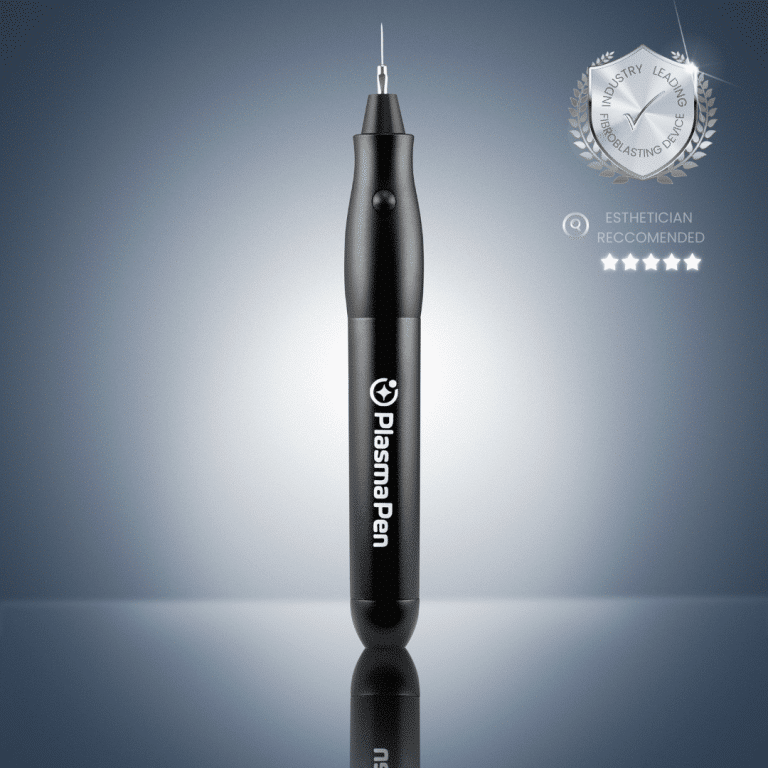
Featured in this article
Our stunning PlasmaPen™ Classic device is primarily geared towards beauty, aesthetics and spa professionals and is designed to underpin all the primary treatments.
All our professional plasma devices are designed for non-invasive soft-surgery and fibroblasting treatments to underpin next-generation skin-lifting, skin-tightening, rejuvenation, resurfacing, revitalization, contouring and regeneration treatments.
Pay in 3 interest-free payments with PayPal*